

aktuelle Ausstellungen
Wenn Sie etwas veröffentlicht wissen wollen, schreiben Sie bitte an
Hildegard Ringena >
Vielen Dank!
Meine 20er Jahre
Lunzenau (D) > 02.02. - 21.07.2024
Auch 2024 wird es eine besondere Ausstellung mit der Stiftung August Ohm geben. Dieses Mal stehen die 20er Jahre im Mittelpunkt und man darf bereits jetzt gespannt sein auf die Auswahl der ausgestellten Objekte zu diesem Thema. Mit der Stiftung August Ohm wurde 2021 die großzügige Leihgabe einer mehr als 1.000 Objekte umfassenden Sammlung für mindestens 25 Jahre an das Museum Schloss Rochsburg vereinbart. Nach Abschluss umfangreicher Baumaßnahmen wird dieser Schatz im Rahmen einer neuen großen Dauerausstellung in denkmalgerecht sanierten Räumen des Schlosses präsentiert werden. Damit wird eine der umfangreichsten und bedeutendsten privaten Mode-Sammlungen Europas auf Schloss Rochsburg eine neue Heimat finden.
Textquelle: Museumswebsite
Veranstalter/ Ort
Schloss Rochsburg
Schlossstraße 1
09328 Lunzenau
Deutschland
weitere Infos: www.schloss-rochsburg.de/sonderausstellung-schloss-rochsburg/
Statement Sleeves
New York City (USA) > 24.01. - 25.08.2024
Whether puffed, ruffled, split, or sheer, statement sleeves have been a ubiquitous fashion trend for the past decade. These dramatic, contemporary creations can enliven and update a wardrobe, yet many current sleeve styles have cycled in and out of fashion for decades, if not centuries. Although sleeves can be especially challenging to make, they also inspire countless creative ideas. Statement Sleeves takes an original approach to the history of fashion. The selected garments date from the 18th century to the present, but they are not presented chronologically. They are instead organized by type. Following an introduction to basic sleeve shapes–from gigot to raglan–visitors will encounter the myriad ways in which designers have reinterpreted and remixed sleeves through variations in material, shape, embellishment, and even functionality. More than sixty styles, all from the museum's permanent collection, emphasize how sleeves hold the power to define a look–in both the past and present.
Text- und Bildquelle: Museumswebsite
Veranstalter/ Ort
The Museum at FIT
New York City
USA
weitere Infos: www.fitnyc.edu/museum/exhibitions/index.php?exhibitions=upcoming
300 years of underwear
Amsterdam (NL) > bis 16.06.2024
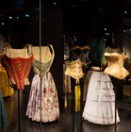
under/wear is a Rijksmuseum Special Collections display tracing shifts in underwear trends between 1640 and 1940 – from linen underpants belonging to 17th-century Dutch ruler Hendrik Casimir I to early 20th-century stocking suspenders. Underclothing was purely functional in the 17th century, but from the 19th century onwards undergarment increasingly became subject to changes in fashion. This was the era of corsets, petticoats, crinolines, chemise undershirts and ‘directoire’ knickers.
Textquelle: Museumswebsite
Veranstalter/ Ort
Rijksmuseum Amsterdam Museumstraat 1
1071 XX Amsterdam
Niederlande
weitere Infos: www.rijksmuseum.nl/en/press/press-releases/300-years-of-underwear-at-the-rijksmuseum
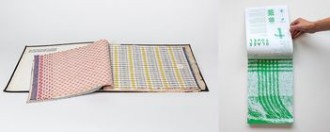
Designed to dry - Kitty van der Mijll Dekker X Vera Roggli
Tilburg (NL) > 27.1.2024 - 12.1.2025
Our relationship with household textiles has changed considerably over the years. In the damask presentation, you will discover more about this history and dive into the story of the - at the time - leading designer Kitty van der Mijll Dekker. This history inspired contemporary designer Vera Roggli. In the 19th and early 20th centuries, people handled household textiles differently than today. For instance, you had different types of cloths in your kitchen, each with its own function (the 'pot cloth', the tea towel, the cook's towel, etc.), the upper class would bring out the pure white damask table linen for special guests or occasions, and young women would collect all the pieces of their textile trousseau in preparation for marriage. The products were often simple in design and mainly focused on functionality. Kitty van der Mijl Dekker is one of the first textile designers of the era to change this.
Bild - und Textquelle: Museumswebsite
Veranstalter/ Ort
TextielMuseum - TextielLab
Goirkestraat 96
5046 GN Tilburg
Niederlande
weitere Infos: textielmuseum.nl/en/exhibitions/designed-to-dry

Cabarets
Moulins (F) > 09.12.2023 - 30.04.2024
À partir du samedi 9 décembre 2023, le Centre national du costume et de la scène propose une exposition sur le thème du Cabaret. 120 costumes provenant de maisons historiques comme le Paradis Latin, le Moulin Rouge, le Lido, le Crazy Horse ou de Chez Michou, ainsi que d’artistes indépendants, qui peuplent les nouveaux cabarets « indisciplinaires », illustrent le large spectre de la création depuis l’excellence des métiers d’art, ateliers spécialisés, créateurs haute couture, jusqu’à celle de la débrouille géniale où tout est imaginé pour faire rêver et proposer une soirée d’exception, hors du quotidien. Un parcours où se croisent de grandes figures comme Line Renaud, Zizi Jeanmaire, Dalida, Barbara, Jean-Marie Rivière, Michou et les créatures fantasques d’aujourd’hui comme la Big Bertha, l’Oiseau Joli, Kiki Béguin, Lola Dragoness Von Flame, Miss Knife… qui revisitent le cabaret avec élégance et insolence.
Bild- und Textquelle: Museumswebsite
Veranstalter/ Ort
Centre national du costume et de la scène
Quartier Villars - Route de Montilly
03000 Moulins
Frankreich
weitere Infos: cncs.fr/a-visiter/cabarets/?utm_source=brevo&utm_campaign=COMMUNICATION%20%20Mois%20de%20dcembre_copy&utm_medium=email
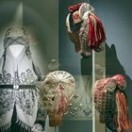
Folk Dress - Festive Dress and Workwear
Oslo (NO) > Dauerausstellung
The independent farmer had an important position in pre-industrial society in Norway. This led to a strong focus on rural culture in the construction of a Norwegian identity toward the end of the 19th century.
Folk Dress
“Folk dress” describes clothing worn by rural people for everyday work, for churchgoing and for other special occasions. Clothes could be distinctive for the region or more generally influenced by urban and European fashion. Regional folk dress could also change over time, partly inspired by international fashion as well as a result of local innovation. Local variations in dress increased noticeably during the 19th century. In some areas, traditional folk dress was in use far into the second half of the 20th century. While fashion is usually categorized chronologically, folk dress has often been sorted according to region. The earliest portrait of a Norwegian farmer and his family (1699) shows a Renaissance influence on rural clothing. Although the portrait comes from the Hallingdal region, the clothing strongly resembles dress used at same time in other areas in southern Norway.
Bunad
Bunads are clothes with historical elements used today only for festive occasions. In some areas, there was a seamless transition from traditional folk dress. In other areas bunads adopted elements from folk dress, such as embroidery, but changed the shape and cut of the garments. Some bunads have been designed in the course of the last century, often with little or no real historical connection. There are approximately 500 different types of bunads in production today. More than 60% of Norwegian women own a bunad.The type of silver worn with traditional folk dress is still used as a part of modern bunads. As a consequence, Norway has a strong living tradition of filigree silver jewelry.
Sami Dress
Traditional Samí clothing is neither characterized as folk dress nor as bunad. An unbroken tradition exists in Samí culture and, even though Samí dress is constantly changing, some medieval traits remain. Samí dress shows great regional variety, largely following dialect boundaries.Today, a vibrant creativity is expressed both in contemporary Samí fashion and jewelry design. Simultaneously, there is a dynamic use of traditional clothing. Many Samí also combine traditional elements with modern garments, to show identity and belonging.
Textquelle: Museumswebsite, Bildquelle: @Haakon Michael Harris / Norsk Folkemuseum
Veranstalter/ Ort
Norsk Folkemuseum
Museumsveien 10, Bygdøy,
0287 Oslo
Norwegen
weitere Infos: norskfolkemuseum.no/en/folk-dress
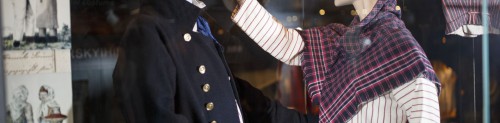
Dressed with pride
Jyväskylä (FI) > Dauerausstellung
The Dressed with Pride section at the National Costume Center of Finland presents traditional outfits from different parts of Finland in various eras. The exhibition also explores the history and the manufacturing methods behind the costumes. The exhibition draws attention to the remarkable level of detail in the costumes: flax and wool fabrics, pewter brooches, colourful stripe patterns on the skirts, headgear, pockets…
Finnish national costumes replicate peasant festive costumes from the 18th and 19th centuries. They continue the popular festive costume tradition, which includes skilfully crafted accessories from felt hats to bonnets, felted wool capes to silk aprons – all hand-decorated using elaborate techniques. Traditional festive costumes often combine various craft skills as well as typical features and materials from different eras. Parts of the costumes were home-made, parts bought or tailor-made by professionals. This tradition lives on in national costumes. The exhibition also raises questions. What happened to these carefully crafted items when they were no longer used?
Text- und Bildquelle: Museumswebsite
Veranstalter/ Ort
The Craft Museum of Finland
Kauppakatu 25
40100 Jyväskylä
Finland
weitere Infos: www.craftmuseum.fi/en/craft-museum-finland/exhibitions-and-events/permanent-exhibitions/dressed-pride
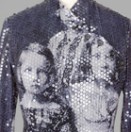
Unpicking Couture
Manchester (GB) > 21.07.2023 - 12.01.2025
Unpicking Couture premieres spectacular high-end fashion which has recently entered Manchester Art Gallery’s collection. Created by influential designers and fashion houses, each outfit represents a groundbreaking moment in fashion and includes works by Christian Dior, Elsa Schiaparelli, Azzedine Alaïa, Cristobal Balenciaga, Pierre Cardin, Vivienne Westwood, Yohji Yamamoto, Bruce Oldfield and Alexander McQueen. This exhibition celebrates pioneering creativity and design. The two main themes of the show are: investigating the links between fashion and emotions, in the form of dopamine dressing which encourages dressing for joy, and focusing on repair and restoration, inviting us to consider the lifecycle of a garment and the way it is valued and cared for. The exhibition will reveal the recent restoration of a 1930s silk velvet jacket by Italian couturier Elsa Schiaparelli, Unpicking Couture promotes sustainable approaches to repairing and preserving much loved and well-worn clothes. The garments will be on display for the first time. They were acquired through a National Heritage Lottery Fund Collecting Cultures grant from 2015-20. Unpicking Couture will expose the work that underpins the care of dress collections through a mediative film that captures the process of dress mounting and how the craft and skill involved, mirrors the work of dressmakers and couturiers. Innovative display techniques have been developed in conjunction with Dr. Jeff Horsley from the Centre for Fashion Curation, London College of Fashion and Dr Angela Piccini from the School of Art, Design and Architecture, University of Plymouth, including dynamic visual and spatial strategies and a focus on the making of the exhibition. These lively modes of presentation provide encounters for fashion as stimulation and immersion, enabling slow looking and inspiring conversation. Part display and part studio space, Unpicking Couture activates ideas around the value and care of collections, sustainability, expression of self, making and creativity.
Text- und Bildquelle: Museumswebsite
Veranstalter/ Ort
Manchester Art Gallery | Gallery of Costume
Mosley Street,
Manchester, M2 3JL
GB
weitere Infos: manchesterartgallery.org/event/unpicking-couture/
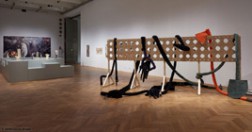
Hard/ Soft. Textil und Keramik in der zeitgenössischen Kunst
Wien (A) > 13.12.2023 - 20.05.2024
Während Textil mit Wärme und Flexibilität assoziiert wird, strahlt die aus weichem Ton oder Lehm geformte Keramik eine kühle Zerbrechlichkeit aus. Und doch zeichnen sich beide Medien durch eine erlebbare Formensprache aus, die zwischen hart, weich, sperrig und fließend changiert. Die Materialien, Formen und Bedeutungen der ausgewählten Objekte eröffnen ein breites Spektrum von Ambivalenzen, Unschärfen und Gleichzeitigkeiten.
Zu sehen sind Arbeiten von rund 40 österreichischen und internationalen Künstler*innen, die in ihrer künstlerischen Praxis auf handwerkliche Techniken wie Sticken, Knüpfen und Weben oder Formen, Kneten und Brennen zurückgreifen. Die Skulpturen, Installationen und malerischen Arbeiten, zu denen auch Stickbilder, Patchworks und Tapisserien zählen, zeigen vielfältige künstlerische Ansätze und Schnittstellen zwischen bildender und angewandter Kunst, Architektur, Musik und dem digitalen Raum. Sie eröffnen Einblicke in Produktionsweisen, Ateliers, Werkstätten und Prozesse der disziplinenübergreifenden Zusammenarbeit. Textil und Keramik vermitteln sich hier als kulturelle Träger von Gemeinschaften; sie sind in ökonomische und politische Systeme eingeschrieben. Neben Materialeigenschaften werden insbesondere feministische Anliegen, die Auseinandersetzung mit dem Körper, Fragen der kulturellen Aneignung sowie Geschlechterzuschreibungen zur Diskussion gestellt.
Text- und Bildquelle: Museumswebsite
Veranstalter/Ort:
MAK
Stubenring 5
1010 Wien
Österreich
weitere Infos: www.mak.at/hardsoft

The Theatre King
Stockholm (S) > Oktober 2023 - Dezember 2024
Experience the splendor, power, and theater costumes of Gustav III's era. For the first time, around fifty unique costumes from The Royal Swedish Opera and The Royal Armoury are displayed together in an exhibition. Join us on a costume cavalcade! The exhibition takes you through the magical world of theater of the Gustavian era. An epoch where the passionate so-called "theater king" Gustav III created an outstanding atmosphere around culture. Where the theater became a space for splendor and spectacle, as well as a tool to wield for political and royal power. The Theatre King is an exhibition in four acts that begins with Gustav III’s resplendent silver coronation costume. It shows the royal cultural life that flourished in the 18th century, with music, dance, artists, grandiose outdoor spectacles, court life and tournaments. The exhibition ends with a costume from Verdi’s opera Un Ballo in Maschera. In this costume, fact and fiction are woven together in a finale worthy of a Theatre King.
Text- und Bildquelle: Museumswebsite (Foto © Jens Mohr)
Veranstalter/ Ort
Livrustkammaren
Slottsbaken 3
11133 Stockholm
Schweden
weitere Infos: livrustkammaren.se/en/the-royal-armoury/exhibitions/the-theatre-king/
Seite 3 von 11