
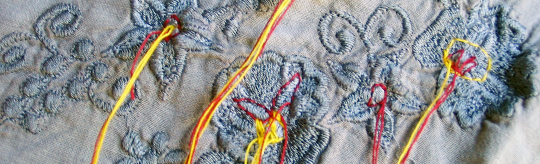

aktuelle Ausstellungen
Wenn Sie etwas veröffentlicht wissen wollen, schreiben Sie bitte an
Nikola Fölster >
Vielen Dank!

Scheren-Schnitt - Lächelnder Schmerz der Modeindustrie
Hannover (D) > 03.04. - 31.08.2025
Mit der aktuellen Sonderausstellung blickt das Museum für textile Kunst zurück: 25 Jahre ist es her, dass die Expo 2000 mit ihrem Motto „Mensch, Natur, Technik - Eine neue Welt entsteht“ die ganze Welt begeisterte.
Die Ausstellung „Scherenschnitt und Zwangsjacke“ des Kirchlichen Entwicklungsdienstes der evangelisch- lutherischen Landeskirche hinterfragte damals als Teil der Expo die Arbeitsbedingungen in der Textilindustrie und ist jetzt Herzstück der neuen Präsentation im MFTK. Mit kunstvoll gestalteten Krinolinen aus Plastik, wertvollen Stickereien und historischen Kleidern stellt Ausstellungsmacherin Erika Knoop die Frage, was sich seitdem getan hat. Sind uns die Lieferketten bewusst? Ist uns in unserer heutigen Zeit Schnäppchenglück immer noch wichtiger als die Folgen des Billigwahns mit seinen Auswüchsen in Billiglohnländern? Was kann jede einzelne Person tun? Und kann die Digitalisierung die Produktionsbedingungen verbessern?
Eine Antwort gibt das Museum direkt vor Ort: In der Ausstellung können Besucher:innen Vintage-Mode erwerben und den Kleidungsstücken ein zweites Leben schenken.
Besonders hervorzuheben sind hierbei durch Upcycling veredelte Textilien aus der Designwerkstatt.
Das MFTK engagiert sich für einen achtsamen, sozialverträglichen und umweltbewussten Umgang mit Kleidung.
Die Dauerausstellung zeigt in einem renovierten Bunker des Zweiten Weltkriegs kostbare Textilien aus aller Welt, die von der Modedesignerin und Museumsgründerin Erika Knoop in über 40 Jahren zusammengetragen wurden.
Text - und Bildquelle: Museumswebsite (Fotos © Kloepperfotodesign)
Veranstalter/ Ort
Museum für textile Kunst (MftK)
Borchersstraße 23
30559 Hannover
Deutschland
weitere Infos: www.museum-fuer-textile-kunst.de

Leigh Bowery!
London (GB) > 18.02. - 31.08.2025
Leigh Bowery’s short but extraordinary life left a distinct, undeniable mark on the art world and beyond. An artist, performer, model, TV personality, club promoter, fashion designer and musician, Bowery took on many different roles, all the while refusing to be limited by convention. From his emergence in the nightlife of 1980s London through to his later daring and outrageous performances in galleries, theatres, and the street, Bowery fearlessly forged his own vibrant path. He reimagined clothing and makeup as forms of painting and sculpture, tested the limits of decorum, and celebrated the body as a shape-shifting tool with the power to challenge norms of aesthetics, sexuality and gender. Embracing performance, club culture and fashion design, Bowery created some of the most iconic images of the 1980s and 90s that continue to resonate, with his influence seen in the work of figures such as Alexander McQueen, Jeffrey Gibson, Anohni, and Lady Gaga. This eclectic and immersive exhibition is a rare chance to experience many of Bowery’s ‘Looks’ alongside his collaborations with artists including Michael Clark, John Maybury, Baillie Walsh, Fergus Greer, Nick Knight and Lucian Freud. It will provide a fresh insight into the creative scenes in London, New York and beyond featuring Sue Tilley, Trojan, Princess Julia, Les Child, Andrew Logan, Lady Bunny, Scarlett Cannon, MINTY and Boy George. Moving from the club to the stage, to the gallery and beyond, step inside Bowery’s dynamic creative world that blurred the lines between art and life. The exhibition is organised by Tate Modern in collaboration with Nicola Rainbird, Director and Owner of the Estate of Leigh Bowery
Text - und Bildquelle: Museumswebsite
Veranstalter/ Ort
Tate Modern
Bankside
London SE1 9TG
Großbritanien
weitere Infos: www.tate.org.uk/whats-on/tate-modern/leigh-bowery
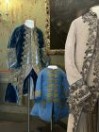
Fashion in the time of Giacomo Casanova
Venedig (I) > 07.03. - 27.07.2025
An icon of a world and a civilisation, Giacomo Casanova is a remarkable key to understanding 18th-century Europe: the world of the great courts and powerful dynasties, exciting encounters with leading figures in art and culture, the enthralling uncertainties of gambling and of the boundless, many-sided theatrical metamorphoses. The exhibition of 18th-century garments – partly from the collections of the Museo di Palazzo Mocenigo, Centro Studi di Storia del Tessuto e del Costume – takes us into the 18th-century world in which Casanova was one of the most illustrious figures. The exhibition, organised in the rooms of the first piano nobile of the museum, already styled in 18th-century Venetian taste, helps us understand how greatly aesthetics formed an essential language, not only in seduction but above all in the social rise of the individual, in an age when appearances were the only way to assert one’s social and economic position.
Text - und Bildquelle: Museumswebsite
Veranstalter/ Ort
Museo di Palazzo Mocenigo
Santa Croce 1992,
30135 Venezia
Italien
weitere Infos: mocenigo.visitmuve.it/en/mostre-en/mostre-in-corso-en/fashion-in-the-time-of-giacomo-casanova/2025/02/21056/exhibition-fashion-casanova/
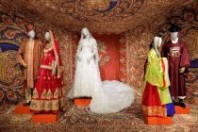
Say Yes - International trends in wedding fashion
Rotterdam (NL) > 31.01. - 26.10.2025
Discover the vibrance and meaning of wedding fashion at the SAY YES exhibition at Wereldmuseum Rotterdam. From January 31 to October 26, 2025, embark on an inspiring journey through wedding traditions and modern designs from various cultures. Be amazed by iconic creations, innovative trends, and the deeper stories behind this extraordinary fashion. Wedding attire is much more than just a dress or suit; it is an expression of identity, tradition, and connection. With SAY YES, Wereldmuseum Rotterdam invites you into the rich world of international wedding fashion. From January 31 to October 26, 2025, explore how wedding styles from different cultures are being rediscovered and how traditional elements are innovatively reinterpreted in contemporary design. In this exhibition, past and present come together in a colourful, inspiring journey through wedding trends. SAY YES highlights seven themes: white, colour, tradition, unconventional, extravagant, simple, and sustainable. From sophisticated creations by fashion icons like Zuhair Murad and Gucci to the playful designs of Dutch designer Bas Kosters, the contemporary vision of Bayanda Khathini from South Africa, and the groundbreaking designs of Queera Wang from New York. In addition to wedding attire, the exhibition also features accessories, jewelry, headpieces, shoes, and historical and modern photographs of newlyweds. Be dazzled by original designs, fresh inspiration, and breathtaking beauty. SAY YES highlights show wedding fashion is not only a symbol of love but also of cultural identity, diversity, connection, and sustainability.
Text - und Bildquelle: Museumswebsite
Veranstalter/ Ort
Wereldmuseum Rotterdam
Willemskade 25
3016 DM Rotterdam
Niederlande
weitere Infos: rotterdam.wereldmuseum.nl/en/whats-on/exhibitions/say-yes?_gl=1*17nk3lh*_up*MQ..*_ga*MTI2NTMxMzk2NS4xNzQyNzYxODU2*_ga_TPGM95SP38*MTc0Mjc2MTg1Ni4xLjEuMTc0Mjc2MjI3NC4wLjAuMA..

Cartier
London (GB) > 12.04. - 29.10.2025
A major exhibition featuring more than 350 objects, including precious jewels, historic gemstones, iconic watches and clocks, that chart the evolution of Cartier's legacy of art, design and craftsmanship since the turn of the 20th century.
Text- und Bildquelle: Museumswebsite
Veranstalter/ Ort
V&A South Kensington
Cromwell Road
London, SW7 2RL
London
Great Britain
weitere Infos: www.vam.ac.uk/exhibitions/cartier
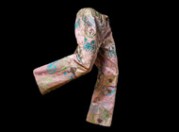
Wer hat die Hosen an?
Wien (A) > 25.03.2025 - 01.02.2026
Eröffnung: 24.03.2025
Ob exakt gebügelt oder im legeren Baggy-Look – sie sind ein globales Phänomen und uns allen scheinbar bestens vertraut. Sie sind Erkennungszeichen kultureller und sozialer Identität und Stoff für modische Statements: Hosen. Das Weltmuseum Wien unternimmt in einer großen Sonderausstellung ab 25. März 2025 einen Streifzug durch 3.000 Jahre Hosen-Geschichte aus aller Welt, von den ältesten Hosentypen der Bronzezeit bis in die Gegenwart.
Text - und Bildquelle: Museumswebsite
Veranstalter/ Ort
Neue Hofburg
Weltmuseum Wien
Heldenplatz
1010 Wien
Österreich
weitere Infos: www.weltmuseumwien.at/ausstellungen/wer-hat-die-hosen-an/

Glitzer
Hamburg (D) > 28.2. - 26.10.2025
Glitzer funkelt und flirrt, fasziniert und empört. Es ist auf Bühnen ebenso zu finden wie auf Protestplakaten und in Kinderzimmern. Glitzer ist omnipräsent – und doch ist das MK&G weltweit das erste Haus, das diesem Material eine Ausstellung widmet. Der Schwerpunkt der Ausstellung liegt auf Glitzer als Symbol für Zugehörigkeit, Empowerment und Selbstbestimmung und beleuchtet den Einsatz in politischen Kontexten und kollektiven Bewegungen. Rund 40 internationale Positionen aus Kunst und Gestaltung widmen sich Glitzer als Ausdruck der Freude an gesellschaftlicher Vielfalt und kollektiver Ausgelassenheit, als Mittel des Protests, der Performance und Popkultur, als Symbol der Sichtbarmachung marginalisierter Gruppen und des Widerstands gegen Körpernormen. Gezeigt werden unter anderem ein glitzerndes Jugendzimmer der Hamburger Künstlerin Jenny Schäfer, Fotografien von Quil Lemons, Skateboards von Mickalene Thomas, GIFs von Molly Soda, Show-Perücken der Hamburger Designer Karl Gadzali und Mohamad Barakat-Götz für Olivia Jones und ein Bühnenoutfit von Bill Kaulitz.
Text - und Bildquelle: Museumswebsite
Veranstalter/ Ort
Museum für Kunst
und Gewerbe Hamburg
Steintorplatz
20099 Hamburg
Deutschland
weitere Infos: www.mkg-hamburg.de/ausstellungen/glitzer

LOUVRE COUTURE Art and fashion: statement pieces
Paris (F) > 25.01. - 21.07.2025
Although we have known since the days of Paul Cézanne that ‘the Louvre is the book from which we learn to read’, this inexhaustible wellspring of inspiration has also nourished one of contemporary art’s liveliest domains: the world of fashion. More and more, research and monographs dedicated to the greats of fashion have boldly begun to trace aesthetic family trees, establishing these figures in a historical and artistic context. The pattern is not merely one of disruptions, with various degrees of radical innovation, or of seasonal changes, but also one of echoes and evocations. The threads weaving their way between the work of great fashion figures and the world of art are almost endless, and the history of art as expressed by the Musée du Louvre, in the depth of its collections and in the ways it reflects the tastes of days gone by, is an equally vast terrain of influences and sources. In consideration of the Louvre’s encyclopaedic immensity, this exhibition follows a methodological approach geared towards exploring the history of decorative styles, art professions and ornamentation through the galleries of the Department of Decorative Arts, where textiles are omnipresent – though generally in tapestries and other décor items rather than in articles of clothing. Over a nearly 9,000-square-metre space, 65 designs are displayed, along with a number of accessories, newly illuminating the close historical dialogue that continues to take place between the world of fashion and the department’s greatest masterpieces, from Byzantium to the Second Empire. Each of these garments and accessories is on special loan from the most iconic fashion houses, both long-standing and recent, in Paris and throughout the world. The pieces will not be displayed aimlessly throughout the Department of Decorative Arts, but rather will serve as an occasion to highlight existing parallels: the department owes part of its collection to the generosity of great fashion figures, from Jacques Doucet to Madame Carven. These countless connections embrace common methodological ground in the fields of art history and fashion: knowledge of ancestral techniques, visual culture and the subtle interplay of references, from the catalogue raisonné of the museum to the moodboard of the fashion world. ‘Louvre Couture’ offers a new perspective on decorative arts through the prism of contemporary fashion design.
Text - und Bildquelle: Museumswebsite
Veranstalter/ Ort
Louvre
Department of Decorative Arts
107 Rue de Rivoli
75001 Paris
Frankreich
weitere Infos: www.louvre.fr/en/exhibitions-and-events/exhibitions/louvre-couture
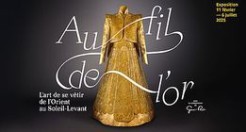
Golden Thread The art of dressing from north Africa to the far east
Paris (F) > 11.02. - 06.07.2025
From the Maghreb to Japan, a fabulous journey through time and space, discovering the mysterious and fascinating origins of gold and its marriage with the textile arts. The world's most precious and noble metal, an object of envy, a symbol of wealth and splendour, a sign of elegance and refinement... Discovered nearly 7,000 years ago, gold has never ceased to fascinate mankind. The ultimate material for all kinds of expertise, experimentation and tradition, it has been used since antiquity to make jewellery, ornaments and weapons. As early as the fifth millennium B.C., it was used to embellish the first luxury fabrics for men of power. Over the centuries that followed, skilled weavers and craftsmen Roman, Byzantine, Chinese, Persian and then Muslim used the most ingenious techniques to create veritable fabrics of art where silk or linen fibres were intertwined with gold threads and strips. From the first ornaments sewn onto the garments of the deceased to the flamboyant dresses of contemporary Chinese artist Guo Pei that are found throughout the exhibition, from the gold-woven silks of the Indian and Indonesian worlds to the glittering kimonos of the Edo era, this exhibition reveals the age-old history of gold in the textile arts. In a dialogue combining scientific discoveries and artistic perspectives, it unveils the dazzling beauty, diversity, richness and the technical nature of the outfits of a vast region from the Maghreb to Japan, including the countries of the Middle East, India, and China.
Text - und Bildquelle: Museumswebsite
Veranstalter/ Ort
Musee du Quai Branly - Jaques Chirac
37 Quai Branly
75007 Paris
Frankreich
weitere Infos: www.quaibranly.fr/en/exhibitions-and-events/at-the-museum/exhibitions/event-details/e/au-fil-de-lor
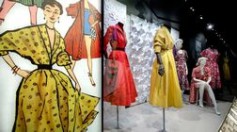
Clothes & Couture
Borås (S) > Dauerausstellung
Clothes & Couture tells the story of the creation of Swedish everyday fashion, which was inspired by the couture exhibitions held in Paris between the 1930s and 1970s. We welcome you to a retrospective exhibition about the Borås company Bröderna Magnusson (‘the Magnusson Brothers’), and its journey through fashion history. In the ‘Clothes & Couture’ exhibition, the Textile Museum of Sweden shows how twentieth-century Paris fashion was reinterpreted to create practical clothes for women in Sweden. The exhibition how the Borås company Bröderna Magnusson Damkonfektionsfabrik AB, like many others in the business, took their inspiration from the undisputed capital of fashion: Paris. The manufacture of and trade in ready-made clothes developed during the twentieth century to become one of Sweden’s staple industries. The town of Borås and the surrounding area became a centre for the ready-made clothing industry, and the garments produced here were sold all over the country. One of the companies was Bröderna Magnusson’s, which manufactured womenswear at a somewhat higher price point, featuring advanced cuts and hand-sewn details. All clothes were designed by the company’s head of design, Ylva Segh, who regularly visited the couture shows in Paris. Bröderna Magnusson’s paid great attention to detail, and the garments were produced using a high level of craftsmanship despite being made in a factory. The Textile Museum of Sweden has created slideshows showing the details of the clothing, and developed patterns based on selected garments that have been transformed into three-dimensional animations so as to show visitors how they were constructed. For those who enjoy sewing themselves, there will be sewing patterns available for purchase. These include the useful ‘Pop-Around’ dress from 1953, which was marketed as an everyday, house and party dress. The exhibition was designed in collaboration with the paper artist Bea Szenfeld and includes both large and small installations by her, inspired by the themes of the exhibition.
Text - und Bildquelle: Museumswebsite
Veranstalter/ Ort
Textilmuseet
Skaraborgsvägen 3A,
Borås
Schweden
weitere Infos: textilmuseet.se/en/exhibitions/exhibitions/2022-03-03-clothes--couture
Seite 5 von 13